Compliance Risk Management: How to Build a Proactive Program (Not a Reactive One)
THIS BLOG WAS WRITTEN BY THE COMPLIANCE & RISKS MARKETING TEAM TO INFORM AND ENGAGE. HOWEVER, COMPLEX REGULATORY QUESTIONS REQUIRE SPECIALIST KNOWLEDGE. TO GET ACCURATE, EXPERT ANSWERS, PLEASE CLICK “ASK AN EXPERT.”
Most compliance programs are built to respond. A new regulation drops, a customer flags a gap, an auditor asks a question, and the team scrambles to address it. That reactive posture is not a compliance program. It is an incident response loop masquerading as one.
Proactive compliance risk management works differently. It identifies and addresses regulatory exposure before it surfaces as a violation, an audit finding, or a product recall. The difference in outcomes, in cost, in speed, and in organizational confidence, is significant.
Quick Answer
Compliance risk management is the continuous process of identifying, evaluating, prioritizing, and mitigating regulatory risks before they result in violations or enforcement actions. A proactive program integrates regulatory monitoring, structured risk assessment, defined ownership, and measurable controls into an ongoing management system rather than a periodic review exercise.
Table of Contents
- What Is Compliance Risk Management?
- Reactive vs. Proactive: What the Difference Costs
- The Core Components of a Proactive Program
- Building the Regulatory Monitoring Function
- Structuring Risk Identification and Assessment
- Assigning Ownership and Accountability
- Designing Controls That Actually Prevent Violations
- Measuring Program Effectiveness
- Where Compliance Risk Management Breaks Down
- The Role of Technology in Modern Programs
- FAQ
What Is Compliance Risk Management?
Compliance risk management is the discipline of systematically identifying and addressing the regulatory risks that an organization faces in its operations, products, and markets.
For global product manufacturers, those risks span a wide surface area: product safety regulations, substance restrictions, labeling requirements, import and export controls, environmental standards, and sector-specific mandates that vary by country and update continuously.
The term “risk management” is key. A compliance program that only tracks obligations is a reference library. A compliance risk management program actively evaluates where those obligations are not being met, scores the potential consequences, drives remediation, and monitors for drift. It is a management discipline, not a documentation function.
Reactive vs. Proactive: What the Difference Costs
The reactive compliance model is familiar to most enterprise teams. Regulatory developments come to attention through external signals: a customer complaint, a supplier notification, an industry publication, or enforcement action against a peer company. The team responds, assesses the impact, and works to close the gap.
The problem is timing. By the time a compliance issue surfaces through external signals, the organization has already been exposed. Products may have shipped to a market with non-compliant specifications. Documentation that should have been maintained was not. Remediation under time pressure costs significantly more than prevention.
Proactive compliance risk management front-loads that work. The organization monitors its regulatory environment continuously, identifies obligations as they develop, assesses impact on specific products and markets before they become acute, and builds remediation into normal operational cycles rather than crisis mode.
The cost differential is not marginal. Organizations that manage compliance reactively typically incur higher remediation costs, carry more audit risk, and face longer time-to-market in regulated jurisdictions. The Use Cases for C2P illustrate how enterprise teams have reduced that exposure through proactive intelligence.
The Core Components of a Proactive Program
A functional proactive compliance risk management program has five interconnected components:
Regulatory monitoring: Continuous tracking of regulatory developments across your relevant jurisdictions and product categories. Not a monthly newsletter. Real-time visibility into proposed and enacted changes.
Risk identification and assessment: A structured process for translating regulatory changes into identified risks, scored by likelihood and impact, with context specific to your product portfolio and operational footprint.
Ownership and accountability: Defined owners for each identified risk, with authority to drive remediation within their function and accountability for closure by an agreed deadline.
Controls and remediation: Specific process changes, documentation requirements, or product modifications that address identified risks. Tracked to completion, not just logged.
Measurement and reporting: Metrics that allow leadership to understand the organization’s current risk posture, track progress on remediation, and make informed decisions about resource allocation.
These components are interdependent. Regulatory monitoring without risk assessment produces information overload with no prioritization. Risk assessment without ownership produces documentation with no action. Controls without measurement produce activity with no accountability.
Building the Regulatory Monitoring Function
Regulatory monitoring is the intelligence function that feeds everything downstream. Its quality determines the quality of your entire risk management program.
Most organizations have historically relied on combinations of manual research, consultant relationships, trade association membership, and regulatory alerts from national bodies. That approach has two structural weaknesses: coverage gaps and lag time.
Coverage gaps are inevitable in a manual model. A team monitoring regulations across 20 or 30 markets cannot systematically track all proposed changes across all relevant regulatory categories. Something will be missed.
Lag time compounds the coverage problem. By the time a regulatory change works its way through manual monitoring processes and into a team’s awareness, the window for low-cost response may have already narrowed.
AI-powered regulatory intelligence platforms address both weaknesses by tracking regulatory developments across thousands of sources simultaneously and surfacing relevant changes in near-real time. C2P monitors over 110,000 regulatory source documents across 195 countries, meaning a product team selling into EU, North American, and Asian markets can monitor all relevant developments from a single intelligence feed rather than maintaining separate monitoring streams for each jurisdiction.
The consequence of any of these failures is the same: a compliance gap that becomes visible only when something goes wrong. A failed audit. A customs hold. A product recall notice. A regulator inquiry.
Structuring Risk Identification and Assessment
Regulatory monitoring tells you what changed. Risk identification tells you what it means for your specific organization, products, and markets.
That translation step requires a structured process. For each significant regulatory development, the assessment should answer:
Which products in our portfolio are potentially affected, and across which markets? What is the nature of the obligation: design change, documentation requirement, testing protocol, labeling revision, or something else? What is the timeline for compliance, and what is the consequence of missing it? What is the current state of our compliance against this requirement?
The answers to those questions produce a risk record: a specific, actionable item that can be prioritized against others and assigned for remediation.
Organizations that try to manage this process informally, through email threads and shared documents, find that it degrades under volume. A formal risk register, maintained in a compliance management system, provides the structure needed to track risks through their lifecycle from identification to closure.
Assigning Ownership and Accountability
Risk identification without ownership is a report. Ownership converts a risk into an action.
Every identified compliance risk needs a named owner: a specific individual with the authority to drive remediation within their function and the accountability to close the item by an agreed date. Generic ownership, assigned to a team or department rather than a person, diffuses accountability and slows response.
Ownership assignment should reflect where the remediation work actually occurs. A risk related to a product design specification is typically owned by an engineering function, not the compliance team. A risk related to missing documentation is owned by the function responsible for generating that documentation. The compliance team’s role is to identify the risk, facilitate the assignment of ownership, and track progress, not to own and resolve every item itself.
Building that ownership culture requires executive visibility. When leadership can see which risks remain open, who owns them, and how long remediation is taking, it creates accountability structures that compliance teams cannot maintain through influence alone.
Designing Controls That Actually Prevent Violations
A control is a mechanism that reduces the likelihood or impact of a compliance risk materializing. Effective controls are specific, operable, and tested.
Specific controls address a defined risk through a defined action. A checkpoint in the component approval process that requires review of new materials against REACH substance restrictions is a specific control. A general requirement that “engineering teams consider regulatory requirements” is not.
Operable controls fit into the workflow of the people executing them. A control that requires a compliance team member to review every engineering change order may work in a small organization but fails at scale. A control embedded in the engineering change management system that triggers a required review when relevant thresholds are met is more operable.
Tested controls are periodically verified against real transactions. A process that looks correct in a procedure document may not be functioning as intended when examined against actual behavior. Testing surfaces that gap before an auditor does.
Evidence Management capabilities in compliance platforms allow organizations to capture the outputs of control execution, creating the audit trail that demonstrates controls are operating, not just defined.
Measuring Program Effectiveness
Compliance risk management programs that cannot demonstrate their effectiveness struggle to maintain organizational investment. Measurement provides that demonstration.
Useful metrics for a proactive compliance risk management program include:
Regulatory change coverage: What percentage of regulatory changes relevant to your product portfolio and markets are being captured through monitoring? Coverage gaps indicate a monitoring function that needs to expand.
Time from regulatory change to risk assessment: How quickly does a new regulatory development translate into a documented risk assessment for affected products? Shorter cycle times indicate a more responsive program.
Open risk age: How long do identified risks remain in the register without closure? Aging open items indicate either remediation capacity problems or ownership accountability gaps.
Control testing results: What percentage of controls are passing testing in each cycle? Declining test performance indicates drift in control execution.
Audit findings rate: Are formal audits revealing issues not previously identified through internal assessment? A proactive program should surface most findings before an external auditor does.
These metrics give leadership a running picture of program health rather than a status that only becomes visible at the moment of an audit or incident.
Where Compliance Risk Management Breaks Down
Even programs with good intentions and adequate resources fail in predictable patterns:
Monitoring coverage that stops at known markets: Teams focused on their largest markets miss regulatory developments in mid-tier or emerging jurisdictions that are increasingly significant for global manufacturers.
Risk registers that are not maintained: A risk register created for an audit and not updated between audit cycles is a historical document, not a management tool. It reflects where you were, not where you are.
Remediation plans without enforcement: Assigning ownership without visibility into progress and accountability for closure produces a list of good intentions. The items do not close.
Compliance isolated from product development: Organizations that run compliance risk management as a separate function from product development will always be chasing. Integrating compliance checkpoints into design and engineering workflows allows risk to be addressed when the cost of change is lowest.
Underinvestment in regulatory intelligence: Organizations that rely on manual monitoring processes are structurally limited in how quickly and comprehensively they can respond to regulatory change. That limitation translates directly into increased exposure.
The Role of Technology in Modern Programs
Building a proactive compliance risk management program at enterprise scale requires technology that can handle the volume and velocity of the regulatory environment.
The regulatory change surface area for a global manufacturer is too large for manual monitoring to cover comprehensively. The number of open risk items is too high for a spreadsheet to manage effectively. The evidence trail required for audit readiness is too complex for document management systems not designed for compliance use cases.
C2P from Compliance & Risks integrates regulatory intelligence, risk assessment, requirements management, and evidence management in a single platform. When a regulatory change is detected across C2P’s library of 110,000+ source documents, it surfaces as actionable intelligence that can be linked to affected requirements, triggering an assessment rather than waiting for manual discovery.
That integration between intelligence and action is what enables genuinely proactive compliance risk management rather than reactive response dressed up with faster alert delivery.
Frequently Asked Questions (FAQ)
- What is the difference between compliance risk management and general enterprise risk management?
Enterprise risk management covers a broad range of organizational risks, including financial, operational, strategic, and reputational risks. Compliance risk management is a specific discipline focused on the risk of violating regulatory, legal, or contractual obligations. In practice, compliance risks feed into the broader enterprise risk framework, but they require specialized expertise and processes to manage effectively. - How do you prioritize compliance risks when you have more than you can address at once?
Prioritization should be based on two dimensions: the likelihood that a given exposure will result in a violation or enforcement action, and the potential impact if it does. Impact should account for financial penalties, market access loss, product safety implications, and reputational consequences. High-likelihood, high-impact risks warrant immediate remediation resources. Lower-priority risks should be documented and monitored on a defined schedule. - What makes a compliance risk management program proactive rather than reactive?
A proactive program identifies and addresses regulatory risks before they result in violations. The defining characteristics are: continuous regulatory monitoring (not periodic review), structured risk assessment processes that run on a defined cadence rather than only in response to incidents, ownership and accountability structures that drive remediation through completion, and measurement systems that provide visibility into program health between formal audits. - How should compliance risk management integrate with product development?
Compliance checkpoints should be embedded at key decision points in the product development process: material selection, component sourcing, design specification, engineering changes, and market expansion decisions. When compliance is integrated into these workflows rather than applied after the fact, regulatory requirements are addressed when the cost of change is lowest and the timeline for response is most manageable. - What role does regulatory intelligence play in compliance risk management?
Regulatory intelligence is the upstream function that makes proactive compliance risk management possible. Without continuous, comprehensive awareness of regulatory developments across your relevant markets and product categories, risk assessment is limited to known obligations. AI-powered platforms that monitor thousands of regulatory sources simultaneously provide coverage that manual monitoring processes cannot achieve, reducing the likelihood that significant regulatory changes go undetected until they create an urgent compliance problem.
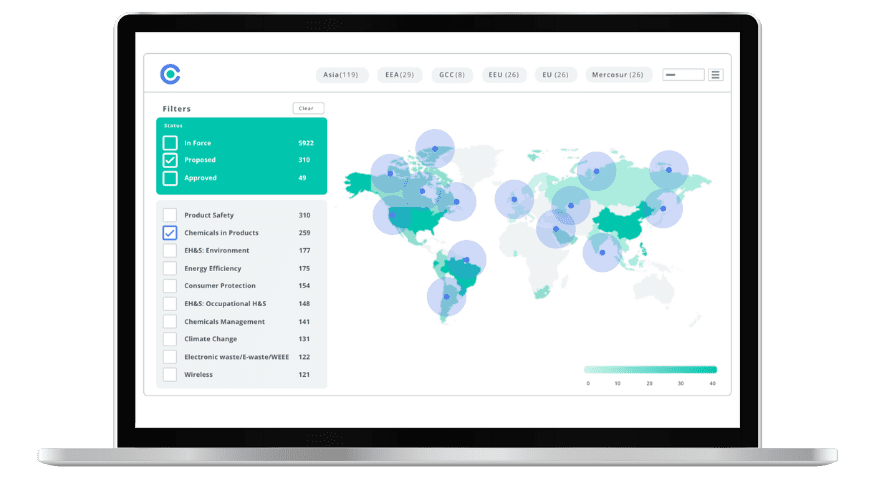
Simplify Corporate Sustainability Compliance
Six months of research, done in 60 seconds. Cut through ESG chaos and act with clarity. Try C&R Sustainability Free.